- 25,000+ participants trained across Taiwan, Singapore, and Malaysia.
- 100,000+ training hours delivered.
- 1 end-to-end talent development framework built.
- 3 assessment and selection tools developed.
- Talent benchmarks established for Gen Z — data-driven insights now guide curriculum design across partner organizations.
"The Foundation's mission is to develop the talent society needs — talent that can contribute to industry and be embraced by employers."
That confidence, shared by Joyce Yang, Director of Corporate Operations Services at WeNET, comes from 16 years of evidence: thank-you notes from participants, referrals from partner companies, and witnessing over 25,000 young people gain the confidence to enter the workforce.
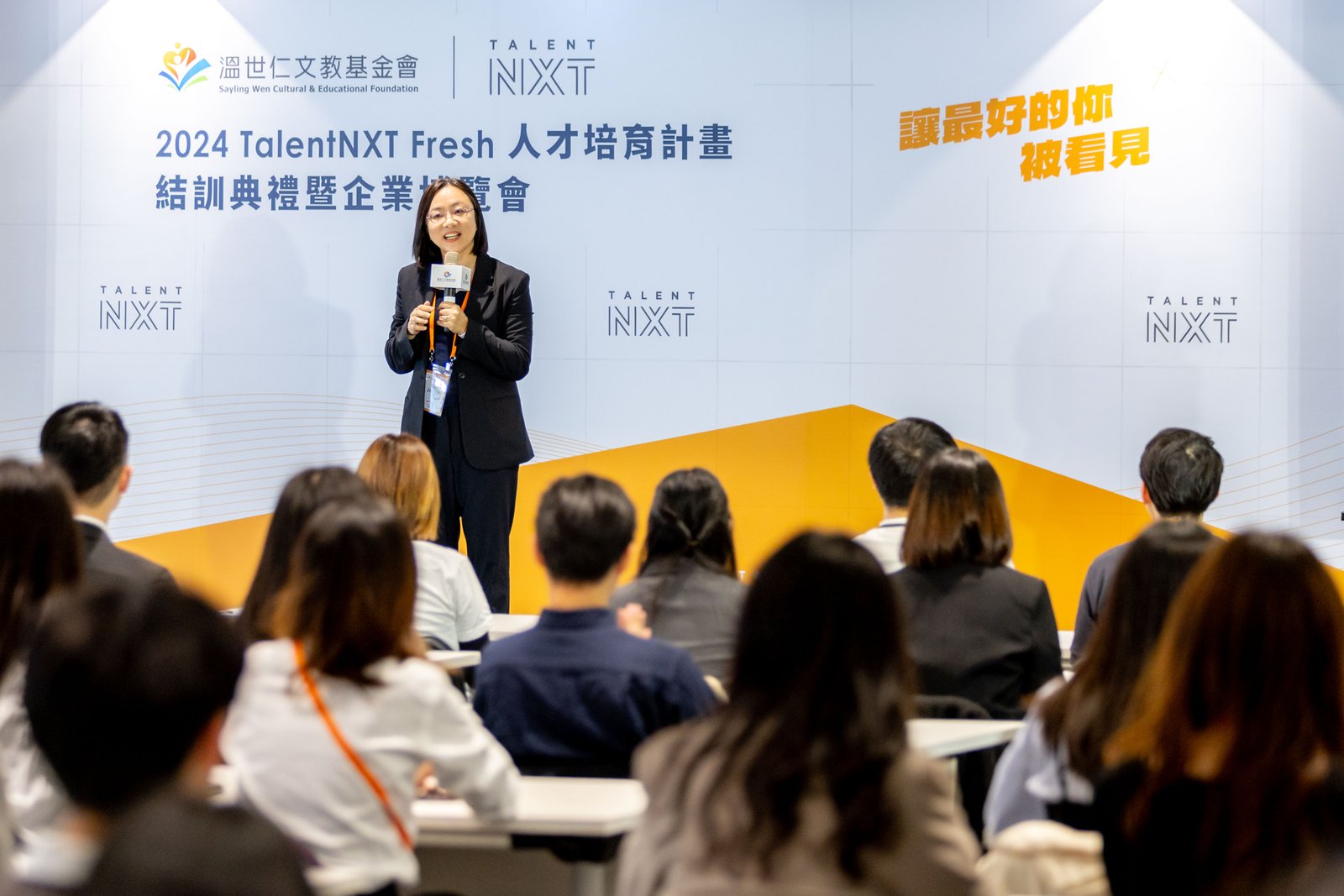
Led by the Sayling Wen Cultural & Educational Foundation, NXT Fresh is one of WeNET's flagship long-term programs.
It focuses on university and graduate students and early-career professionals within two years of the workforce, and sets out to narrow the gap between education and employment. Its emphasis on workplace readiness draws applicants from more than 160 colleges and universities each year — students from roughly 80% of Taiwan's higher-education institutions.

Bridging the Gap Through Four Essential Workplace Competencies
The program didn't start in its current form. Launched in 2010 as the WISE Program, it initially focused on university students and encouraged team-based innovation. Over time, the Foundation identified a recurring problem: "The education students received in school didn't fully align with what industry needed." The Foundation's goal shifted: it now wanted to cultivate talent that could truly meet industry needs — which meant moving the point of intervention closer to workforce entry.
In 2020, the program rebranded as NXT Fresh, targeting junior and senior university students, master's students, and early-career professionals within two years of graduation. WeNET's HR team played a pivotal role in that transformation.
"Coming from a corporate HR background, I can describe exactly what employers value most when a fresh graduate walks in the door," says Joyce.
Those insights shaped the curriculum's four core competencies: Mindset, Communication, Documentation, and Tracking — not intuition, but the result of joint research with National Central University's Graduate Institute of Human Resource Management.

WeNET leads curriculum planning year-round, adjusting themes to match industry trends. In 2024 the focus was service design and AI; in 2025, career exploration. "The Foundation has strong ties to academia, but less experience in providing industry-focused career guidance. That is precisely where the WeNET HR consulting team adds value," Joyce adds. The Foundation oversees program governance and academic partnerships, while the WeNET leads program design and implementation, creating a highly complementary collaboration model.
NXT Fresh is as much a filter as it is a training program. Every stage is designed to do double duty: teach the students something — and show the Foundation who they really are.
The funnel starts wide. Open recruitment draws 1,000 to 2,000 registrations per cohort. Applicants must then complete a detailed application covering five areas, from their understanding of public service to their career goals and how they've navigated personal challenges — a first cut that separates the committed from the casually interested.
The interview round is built around scenario-based conversations and group tasks: candidates are randomly assigned to teams of strangers and given a task to complete against the clock.
"In a short time, you see a person's true nature," says Joyce.
The round measures not just ability, she adds, but attitude — the quality employers say they value most.
Those who pass must complete 10 online courses and pass the accompanying exams before advancing to in-person training, which unfolds in two phases: a career-development workshop, followed by an intensive two-day, overnight team camp. The overnight format is deliberate.
"That's when you see a different side of the students," Joyce says. "Whether they can stand on their own. Whether they can be an adult."
Only those who clear every stage earn a certificate of completion and become officially certified Fresh participants of the Foundation.
Deep Engagement Beyond Training: From Mentorship to Industry Connections
A NXT Fresh certificate is more than a credential — it's the gateway to the next stage. Once participants graduate, the Foundation matches each of them with an industry mentor for three to four months of coaching.
WeNET designed the mentorship framework: participants are matched by career interest (marketing, HR, and others), with monthly one-on-one sessions and regular group discussions.
"You often spot problems you'd never have noticed in your own situation by hearing about someone else's," Joyce observes.
The idea is shared learning and growth, not one-off consultations.

The team also tracks how often — and how well — mentors and participants engage, so the mentorship never becomes a formality, and it adjusts to where each person is: still job-hunting, newly employed, or a little further in.
"The first three months are about adapting; the next three are about positioning yourself for what's ahead," Joyce explains.
This stage-by-stage design is what most sets the program apart from conventional training.
Top graduates can also join overseas exchanges; in both 2024 and 2025, participants visited Singapore and Malaysia for industry visits. Alumni have become the program's most convincing advocates.
"Hearing it from them is far more persuasive to the next cohort than anything the Foundation could say in its own promotions," Joyce says with a smile.
Asked what has stayed with her most, Joyce reaches back three years, to a student who didn't make the first cut. His problem wasn't ability — it was force. He dominated his group in the scenario interview, and his teammates felt it.
Then the rejection letter went out, and something unusual happened: he wrote back. Then he called. He wanted to explain himself, and he wanted another chance. "He came back to fight for it," Joyce says, "and he told me himself he was ready to listen more." She let him back in. Over the rest of the program, he did the harder work of noticing his own patterns and adjusting them — and he completed the program.
At the end, he left her a note.
"Just as you said, change always comes with a little discomfort," he wrote. "But I like the person I've become — someone easier to be around. Thank you for your encouragement and care."
Another card has sat beside her desk ever since a student gave it to her.
"You told me, from your own experience, not to rush — and that saved me," it reads.
"You were the warmest light in a long, dark tunnel. Thank you."
None of it appears in any KPI. But for Joyce and the WeNET HR consulting team, it is the reason they have kept at this for 16 years.

The Foundation plays a neutral role, building the transferable workplace skills industry needs without competing with universities or duplicating government certifications. WeNET adds the industry lens, threading practical expertise through every critical stage.
For companies, talent is both a core advantage and the hardest thing to build.
"A lot of companies today know they should invest in talent — they just don't know where to start," Joyce says.
Rather than waiting until people are already on the job and then patching the gaps, she argues, prepare them before they arrive: put the right people in the right roles from the outset, and the business grows on steadier ground.
"We're always learning something new," she says of the team, which stays flexible and open, shaping different HR programs around each client's needs — from recruitment and training to building talent-management systems.
In a market that increasingly prizes people who can contribute from day one, WeNET has spent 16 years proving a simple point: good talent development is never a single training course. It takes care at every stage — from needs research and curriculum design to selection, mentorship, and coaching well after graduation.
Interviewee: Joyce Yang, Director of Corporate Operations Services